What Is an AI Storyboard Generator?
An AI storyboard generator is software that creates storyboard frames from a script, shot list, or text prompt—using image models to visualize scenes, camera angles, and character blocking faster than hand-drawing every panel. The useful version is not a random image batch. It keeps screenplay context, character references, shot order, and review notes attached so boards can guide animatics, client approval, and AI video generation instead of living in a separate folder.

Definition
AI storyboard generator, defined
Standalone generators can produce fast concept frames. Production-grade generators connect to the script, reuse cast and location references, preserve scene order, and support revision when dialogue or coverage changes.
The difference matters for film teams: a generator that outputs pretty panels without metadata creates rework. A generator inside a pipeline creates boards that downstream animatics, previz, and video generation can trust.
For the full commercial workflow—not just one-off images—see AI storyboard software for film teams in Ciaro Pro.
Definition
An AI storyboard generator is a tool that uses artificial intelligence to produce storyboard images from written scene input—screenplay text, beat descriptions, or shot prompts—often with optional camera, style, and character controls.
How it works
How does an AI storyboard generator work?
Import or write scene input
Screenplay scenes, sluglines, or shot descriptions provide narrative context for each frame.
Define shots and coverage
The system or user specifies wide, medium, close, insert, and reaction panels per beat.
Apply references
Character sheets, location looks, wardrobe, and style guides keep panels visually coherent.
Generate and rank frames
Image models produce candidate panels; directors pick, revise, or regenerate until coverage is approved.
Export to review or production
Approved boards feed animatics, client decks, shoot planning, or video generation from those frames.
Benefits
Why teams use AI storyboard generators
Speed without starting from blank panels
First-pass frames arrive in minutes, leaving human time for coverage and performance decisions.
Lower cost for early exploration
Test multiple visual directions before committing to a full storyboard artist pass or shoot.
Script fidelity
Scene-linked generators stay closer to sluglines, cast, and dialogue than generic prompt tools.
Bridge to AI video
Approved frames become references for image-to-video when the pipeline is connected.
Workflow example
From script scene to generated board
- 1
Select a screenplay scene
The generator reads slugline, characters present, and action lines for the beat.
- 2
Plan three-shot coverage
Wide establishes space, medium carries dialogue, close-up lands the emotional turn.
- 3
Attach cast references
Character sheets keep the lead recognizable across panels in the same scene.
- 4
Review and lock the board
The director replaces weak panels, adds notes, and approves the sequence for animatic or generation.
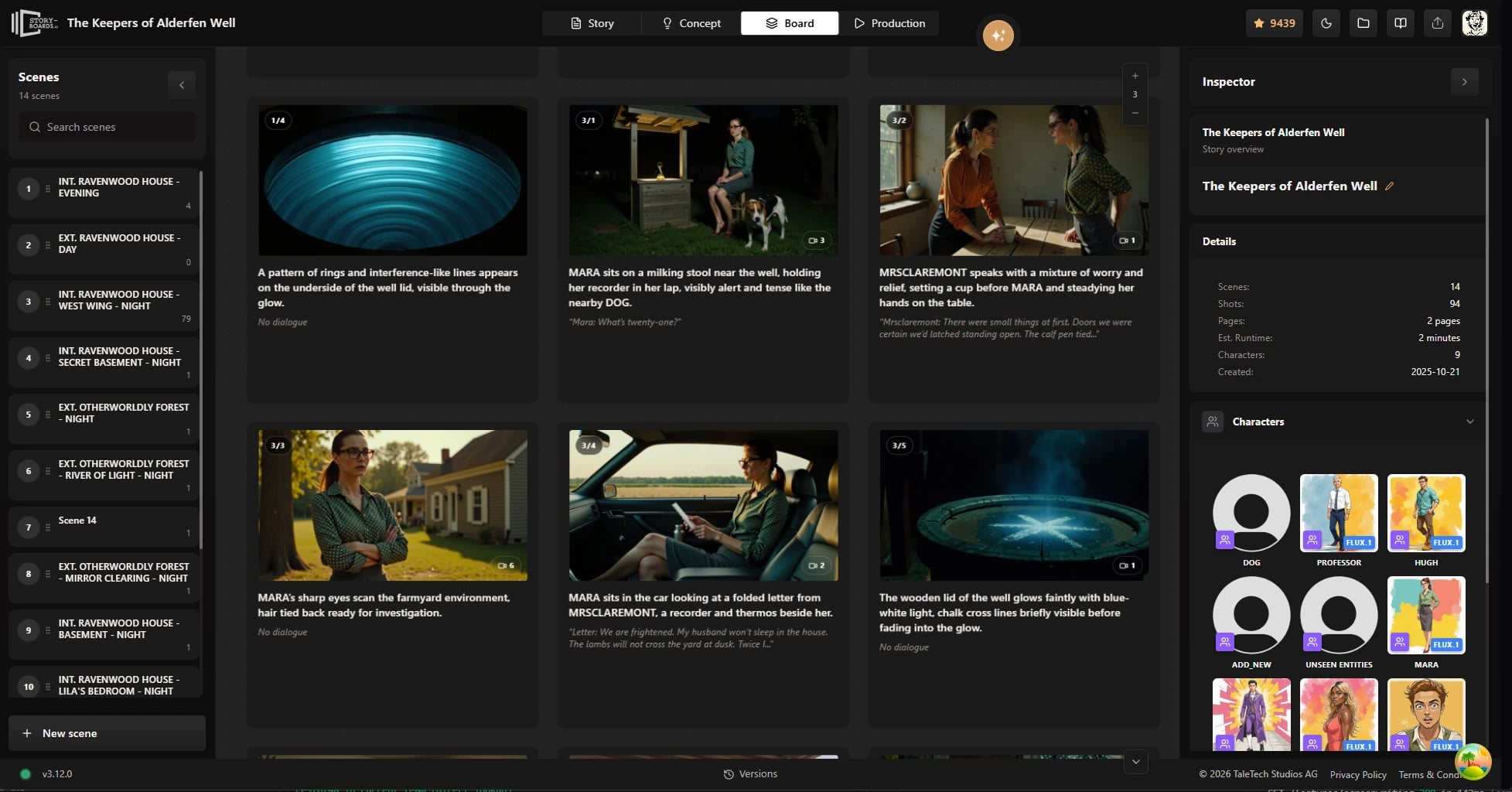
Understand the full handoff in our script to storyboard workflow answer page.
Comparison
Prompt toy vs production generator
Capability
Production generator
Generic prompt tool
Script context
Scene, cast, and slugline aware
Manual copy-paste per prompt
Character continuity
Reusable reference assets across panels
Random faces shot to shot
Shot order
Board sequence matches screenplay coverage
Unordered image gallery
Next step
Animatic, review, AI video, timeline
Download images and restart elsewhere
Use cases
Who uses AI storyboard generators?
Rapid previz
Board dialogue scenes and action beats before committing to a shoot or render farm.
Client concepts
Generate multiple visual directions for a spot while keeping script beats intact.
Layout prep
Create timed board passes faster before hand-drawn cleanup or 3D layout.
Governed generation
Use approved panels as the only source for image-to-video instead of free-form prompts.

Proof
A generator is not a storyboard department
Image tools can make a pretty still. Production storyboarding needs the script, the shot, review status, and a path into video. Ciaro Pro keeps those linked.
Script
Boards stay tied to scenes
Shots
Coverage and camera intent on the card
Review
Approve frames before you generate motion
Handoff
Approved boards become video takes
FAQ
Frequently asked questions
Can AI generate storyboards from a script?
Yes. Script-aware generators parse scenes and produce candidate panels for each beat or shot. Quality improves when the tool understands sluglines, cast, and scene order rather than treating each prompt as isolated.
What is the best AI storyboard generator?
The best choice depends on workflow. For one-off concept frames, simple prompt tools may be enough. For film production, look for script linkage, character references, revision history, review sharing, and a path to animatics or AI video without exporting loose images.
Are AI storyboards good enough for professional use?
They are strong for previz, client alignment, and internal planning. Final marketing boards or style-heavy campaigns may still need artist polish. Many professional teams use AI for first passes, then refine hero frames manually.
How is an AI storyboard generator different from AI storyboard software?
A generator emphasizes frame creation. Storyboard software includes the surrounding production system: script import, shot metadata, collaboration, approvals, animatic timing, and integration with video generation or edit. Generators inside software are more useful for teams.
Do AI storyboard generators replace storyboard artists?
They reduce the time spent on repetitive first passes and exploration, but directors still decide coverage, performance, continuity, and what clients see. Artists remain valuable for style-critical work and complex action design.
Explore next
Related answers and features
Generate boards that production can use
Ciaro Pro connects script scenes, AI storyboard generation, review, and storyboard-to-video workflows in one pipeline.
Sua visão, plano a plano.
Comece grátis. Amplie quando a produção estiver pronta.