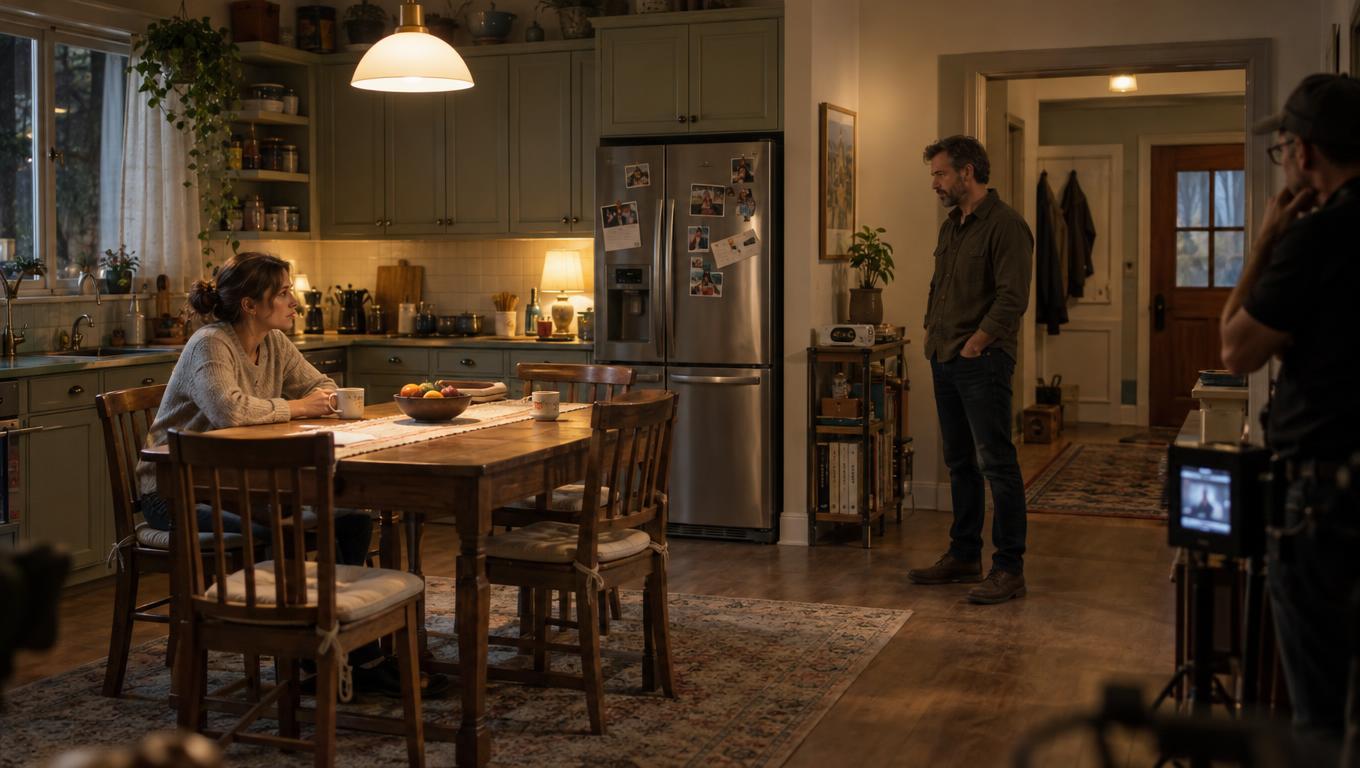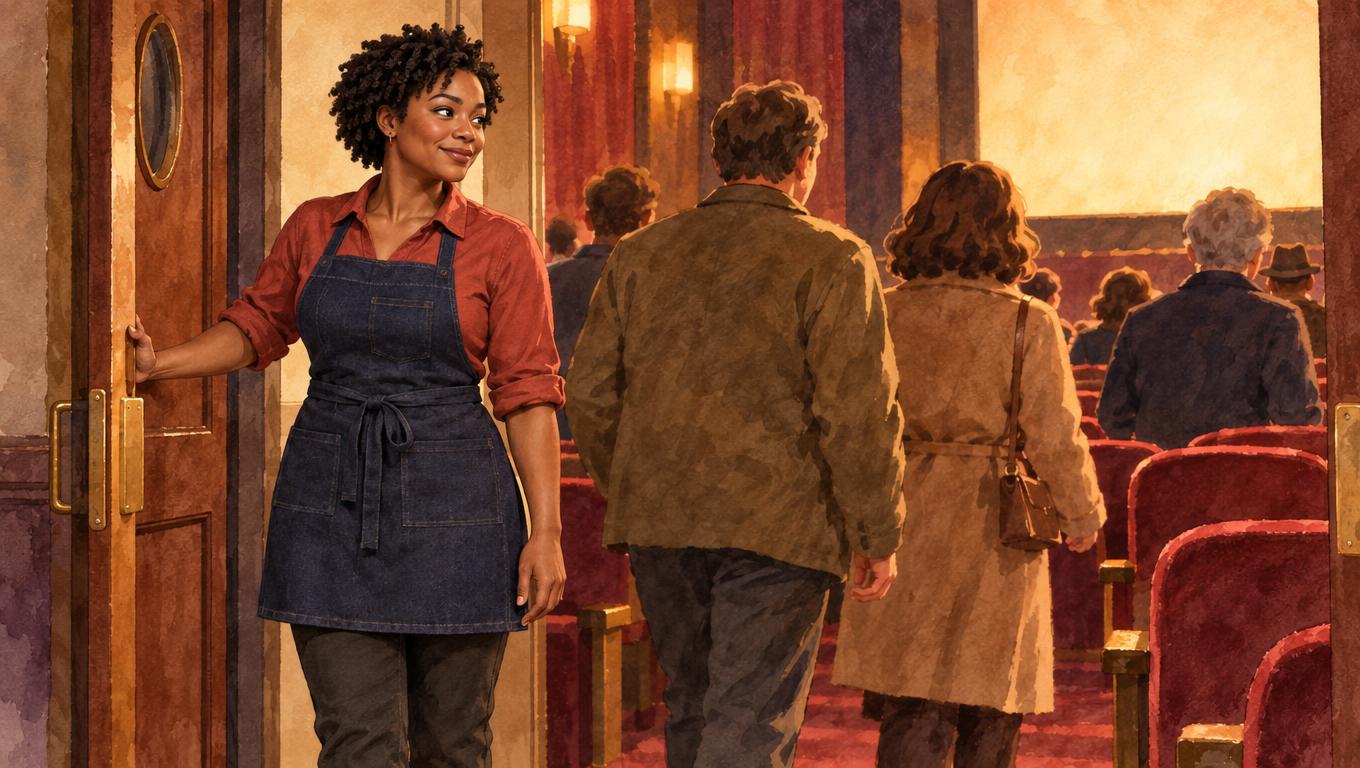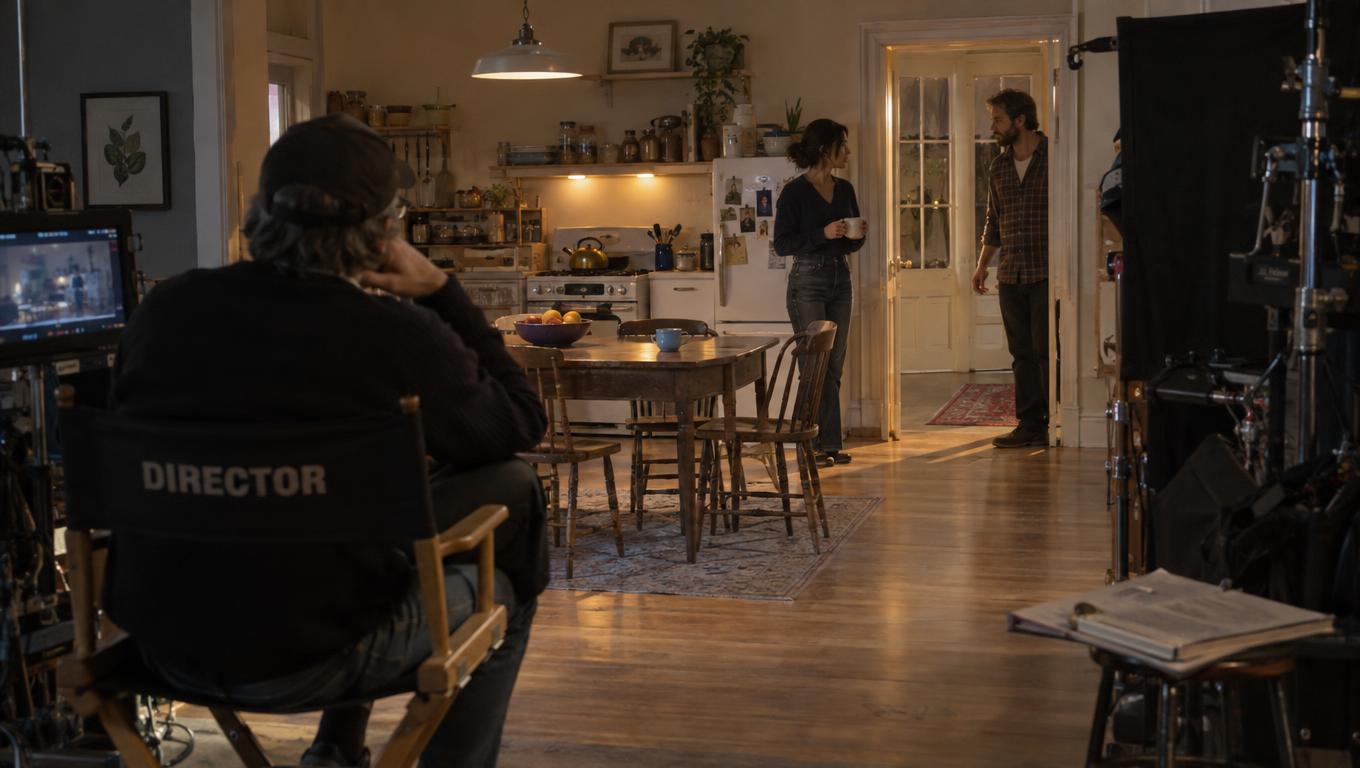
A striking image is not necessarily a proposed shot
An AI image generator can produce a kitchen that feels lonely without showing how to film the person inside it. The colours, furniture and light may suggest the right emotional world, while the relationship between the subject and the doorway remains impossible to read. That image can still be useful, but it answers a different question from a frame intended to communicate a specific shot.
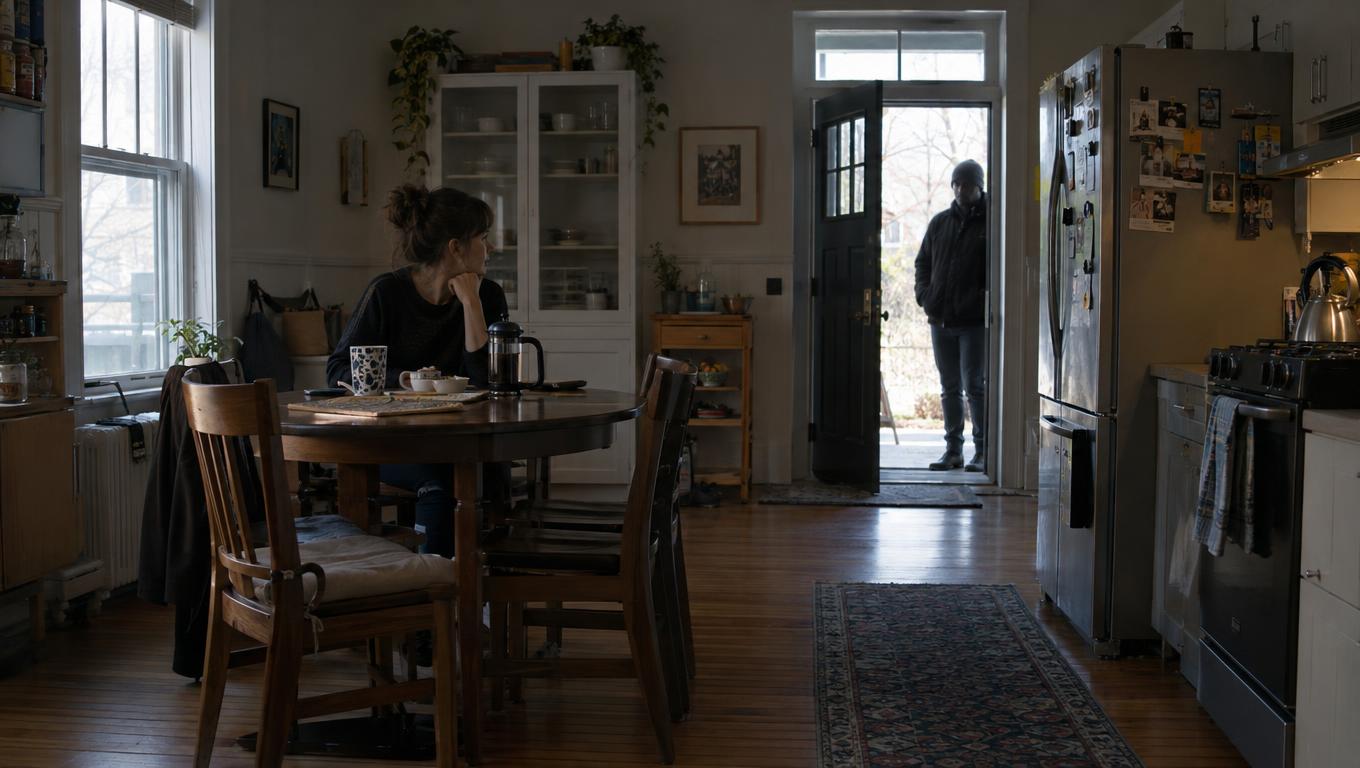
Consider this hypothetical brief: a woman sits alone at a kitchen table while someone enters through a doorway behind her. The camera is near her eye level, positioned diagonally across the table so that her face appears in three-quarter view and the doorway is visible in the background. She faces away from the doorway; the audience should notice the arrival before she does.
Cool window light from camera-left picks out the woman and gives the entrant’s outline enough contrast to register, while leaving their identity uncertain.
That is a proposed dramatic and visual choice, not a prescription for the finished film. It gives a director and cinematographer something concrete to assess: does the image put the audience ahead of the woman while keeping her isolation central? A frame may capture the atmosphere beautifully and still leave that shot unresolved.
Read the composition before the detail
In the proposed frame, the woman needs enough visual weight to hold attention even as the audience notices the doorway. Her placement, scale and separation from the background all contribute. Space around her at the table might support the intended isolation; a large entrant placed close to the centre could make the image read primarily as an entrance instead.
Imagine a frame in which the woman occupies the left foreground and a small, dark figure crosses the threshold in the right background. If both remain distinct at thumbnail size, the composition may communicate the desired order of attention: first the woman, then the arrival. If the figure merges into a dark wall, the image may conceal the arrival itself rather than merely the entrant’s identity.
The distinction matters because obscurity can be intentional. A partial silhouette can tell the audience someone has entered without revealing who. The director can then decide whether that degree of uncertainty serves the scene; the image does not need a detailed face to be useful.
Check what the camera lets the audience know
The diagonal camera position in the brief should show the woman’s face and the doorway in the same frame. Her orientation also matters: if she is facing away and nothing in the image suggests she has turned, the audience can plausibly see the entrant before she does. A generated frame that places her facing the doorway changes that dramatic relationship, even if its lighting and kitchen design are appealing.
A camera behind the woman would create a different question. It might reveal the entrant to the audience over her shoulder, but that position alone would not establish what she can see. Her head direction, the doorway’s position and any obstruction between them would still matter. If she faces away from an entrant who is behind her, the camera cannot be assumed to represent her line of sight.
Look at the room as well as the people. Suppose a frame shows the threshold and the near edge of the table, but the table seems to run into the doorway, or the entrant’s feet appear on a floor plane inconsistent with the woman’s chair. Those visible cues make it difficult to tell whether the entrant is actually behind her in the room or merely appears behind her in the two-dimensional image. The frame may still express the right mood, but staging it would require a new spatial decision.
Not every wall or off-screen area needs an explanation. If the visible threshold, table and figures support the intended relationship, the unseen side of the kitchen can remain open for the designer and cinematographer to develop. A still can suggest camera height, apparent distance and perspective; it cannot reliably specify an exact focal length, a camera move or the complete layout beyond its edges.
That is also where a concept frame differs from a storyboard. A single image can propose the look and composition of a moment. A sequence of storyboard panels can show how that moment connects to other shots and how an action develops across them, although the panels may still leave timing and movement to be worked out.
Separate a lighting idea from atmospheric glow
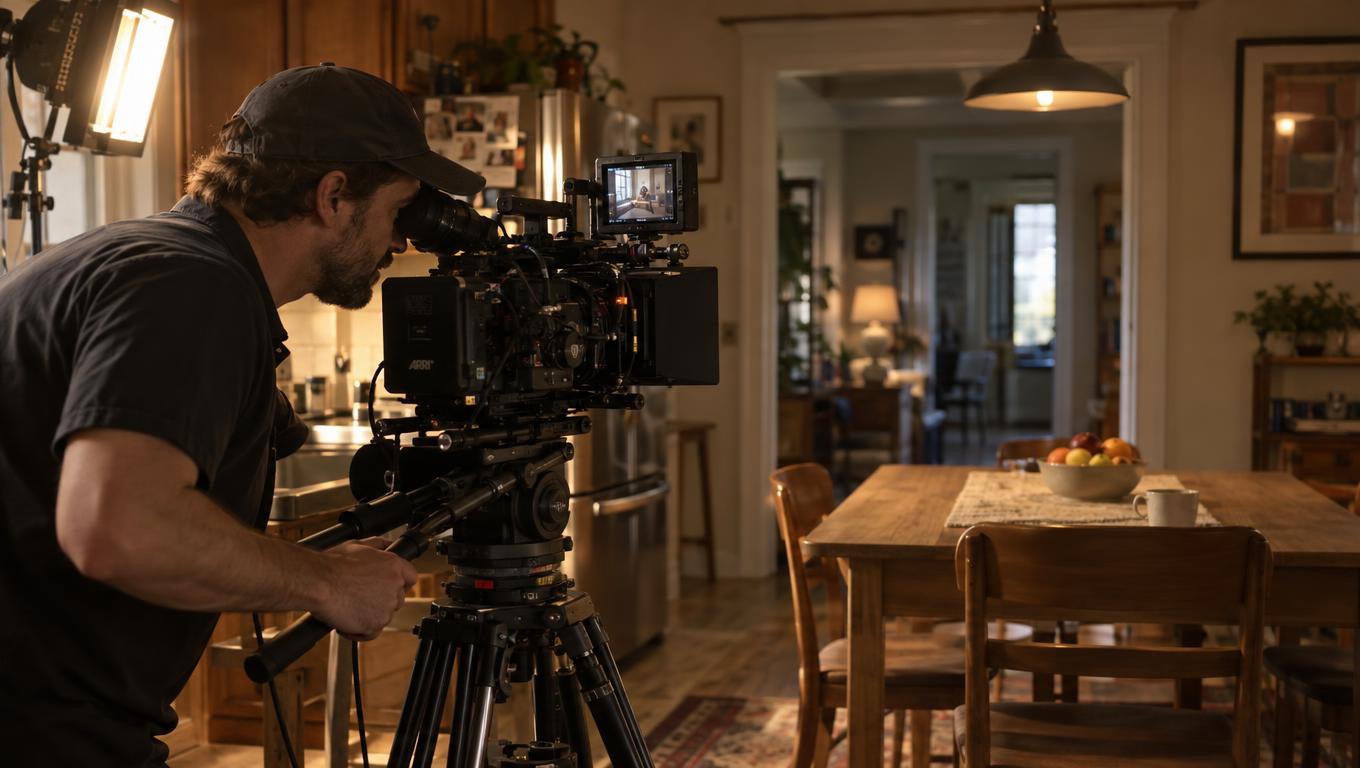
For the hypothetical brief, the light is meant to come from camera-left, picking out the woman while separating the entrant from the background. Look for cues that support that reading: highlights on the camera-left side of the woman’s face or shoulder, a corresponding shadow across her other side, and some edge or tonal separation around the entrant. A bright patch near a window may suggest atmosphere, but it does not by itself show how the figures are lit.
Those cues need not form a perfect lighting diagram. They should, however, be consistent enough to make the intended contrast discussable. If the entrant’s outline disappears against the wall, the frame may fail the arrival beat. If their face is brightly exposed, it may reveal more than the brief intends. Conversely, if the woman’s face vanishes into darkness, the shot may withhold her reaction as well as the entrant’s identity.
Even a convincing frame does not prove the look is achievable in a particular kitchen. The apparent light direction is a starting point for discussion with the cinematographer, not evidence of which fixtures, exposure or location conditions would reproduce it.
Judge details by what they change in the scene
A detail is especially useful when it affects how the action reads. In this scene, the woman’s chair facing away from the doorway helps explain why she may not notice the arrival. A reflective cupboard door that clearly shows the entrant could instead suggest she has a way to see them, changing the audience’s understanding of her awareness. Either choice could be interesting, but each implies a different scene.
A patterned tile wall or carefully arranged crockery may add texture without settling that dramatic question. Such details are not failures: they may establish a period, palette or character for the kitchen. If those qualities are the image’s strongest contribution, keep it as a visual-world reference rather than asking it to settle the staging.
Assess the frame’s strongest choice and biggest gap
Consider a possible frame with the woman isolated in the foreground, the entrant clearly silhouetted in the doorway, and light that keeps both readable. It communicates much of the brief. But if the table and threshold overlap in a way that makes their depth relationship uncertain, the next discussion is not about generating finer textures. It is about where the doorway sits and how the camera sees past the woman. The composition may be worth retaining while that spatial choice is developed separately.
The opposite frame could have a persuasive cold palette and an evocative kitchen but no legible entrant. It may be valuable for tone, yet it does not demonstrate the proposed audience-first arrival. Naming that distinction helps the team preserve a useful image without treating it as a decision it has not made.
If you compare image and video models later, treat the exercise as a test of this brief rather than a universal ranking. Keep the core prompt and intended aspect ratio consistent where possible, and generate more than one output per tool if access permits. Record the date, tool and model versions, references, output count and selection method. Defaults and available controls may differ: note settings that could not be matched, as well as relevant defaults left unchanged.
Retain representative frames so others can check the assessment against the images. A small test describes results under those conditions, not every possible use of a tool. For the next review, take one frame and name the exact choice it communicates—such as the audience seeing the entrant before the woman does—then identify the most important choice it leaves unresolved. That gives the conversation a direction without mistaking polish for a finished shot.